How Much Space Do Chickens Really Need?
One of the first questions new chicken keepers ask is:
How much space do chickens actually need?
You’ll find plenty of numbers online, but the answer isn’t quite as simple as choosing a coop based on how many chickens the manufacturer says it can hold.
The amount of space your flock needs depends on the size and breed of your chickens, how much time they spend inside the coop, whether they free-range, your climate, and the personalities within your flock.
One rule is almost universal, though:
When it comes to chickens, more space is usually better.
Let’s break down how much room your flock really needs.
The General Rule for Coop Space
For standard-sized chickens, a commonly used starting guideline is approximately:
4 square feet of indoor coop floor space per chicken.
For example:
- 4 chickens = approximately 16 sq. ft.
- 6 chickens = approximately 24 sq. ft.
- 8 chickens = approximately 32 sq. ft.
- 10 chickens = approximately 40 sq. ft.
This is a starting point, not a guarantee that every flock will thrive with exactly that amount.
Larger breeds may benefit from considerably more space, while some bantams can comfortably use less.
If your chickens spend long periods confined inside because of winter weather, predators, or other circumstances, providing additional space becomes even more important.
How Much Run Space Do Chickens Need?
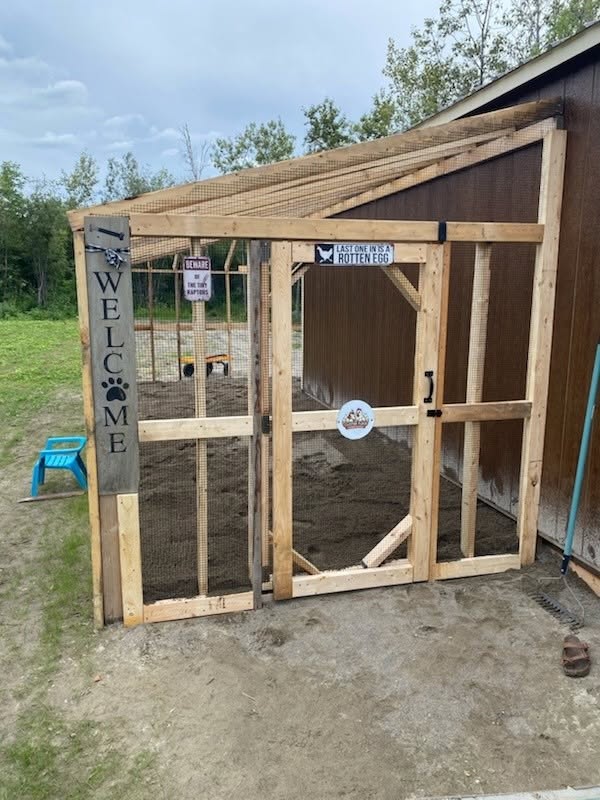
If your flock doesn’t free-range throughout the day, they’ll need an outdoor run.
A commonly recommended starting point for standard-sized chickens is around:
8–10 square feet of run space per chicken.
More is even better when possible.
So, for example:
6 chickens × 10 sq. ft. = approximately 60 square feet of outdoor run space.
An 8 ft. × 8 ft. run provides 64 square feet.
That may sound like a lot when you’re first designing your chicken area, but chickens use their outdoor space constantly.
They need room to:
- Scratch
- Forage
- Dust bathe
- Stretch their wings
- Explore
- Sunbathe
- Exercise
- Move away from dominant flock members
A larger run also gives you more opportunities to provide enrichment and create different areas for your flock to explore.
Why More Space Matters
Chickens are social animals, but that doesn’t mean they want to be sitting on top of each other all day.
Every flock develops a pecking order.
When chickens have adequate space, lower-ranking birds can move away from more dominant flock members.
When space becomes too limited, they may not have anywhere to escape.
Overcrowding can contribute to problems such as:
- Feather picking
- Bullying
- Fighting
- Stress
- Dirty bedding
- Excessive manure buildup
- Increased moisture
- Poor air quality
- Competition around food and water
Sometimes behavioural problems blamed on a “mean chicken” are actually being made worse by the environment.
Giving the flock more room can make a significant difference.
Large Chicken Breeds Need More Room
Not every chicken takes up the same amount of space.
A Brahma and a Serama are technically both chickens.
They are most definitely not the same size of chicken.
Large breeds such as:
- Brahmas
- Jersey Giants
- Cochins
- Orpingtons
may benefit from additional coop, run, roosting, and nesting space.
If you’re planning a flock of especially large chickens, don’t design your setup around minimum recommendations.
Give those fluffy butts some room.
What About Bantams?
Bantams are much smaller than standard chickens, so they can often be comfortably housed using less space.
However, don’t take this to mean that bantams should be crammed into tiny coops.
They still need enough room to exercise, forage, establish their pecking order, and perform normal chicken behaviours.
Extra space is rarely wasted.
In fact, bantams can be incredibly active little birds.
Tiny chicken does not necessarily equal tiny personality!
How Much Roosting Space Do Chickens Need?
Chickens naturally sleep on roosts.
As a general starting point, provide approximately:
8–12 inches of roosting space per standard-sized chicken.
Larger breeds may need more.
Bantams may need less.
It’s a good idea to provide more roosting space than you think you’ll need.
Your chickens will probably ignore half of it and squish together in their favourite spot anyway.
But having additional room gives lower-ranking birds somewhere else to sleep if necessary.
Roosts should be sturdy, appropriately sized, and positioned so birds can safely get on and off them.
How Many Nesting Boxes Do You Need?
Here’s some good news:
You don’t need one nesting box per hen.
A common guideline is approximately:
1 nesting box for every 3–4 laying hens.
So if you have:
- 4 hens → 1–2 boxes
- 8 hens → 2–3 boxes
- 12 hens → 3–4 boxes
Of course, there’s an important chicken-related disclaimer.
You can provide four absolutely beautiful nesting boxes.
Three will remain perfectly empty.
Every hen will want to lay in the same one.
There may even be a hen sitting on top of another hen.
Nobody knows why.
The chickens have voted.
That’s the good box.
Free-Ranging Doesn’t Replace Coop Space
If your chickens free-range during the day, you may be able to manage with a somewhat more compact outdoor enclosure because the birds spend much of their waking time exploring.
However, free-ranging doesn’t mean the indoor coop can be overcrowded.
There will inevitably be days when chickens spend more time inside.
This may happen because of:
- Heavy rain
- Snowstorms
- Extreme cold
- Extreme heat
- Predator activity
- Illness or quarantine situations
- Temporary flock confinement
Your coop still needs enough room to keep everyone comfortable during periods when they can’t roam freely.
Climate Makes a Difference
Where you live can have a major impact on how much indoor space your chickens need.
In warmer climates, chickens may spend almost all day outdoors throughout the year.
In areas with long winters, your flock may occasionally decide:
Absolutely not.
And refuse to step into the snow.
If your chickens regularly spend extended periods inside during winter, additional coop space can be very helpful.
You can also provide covered outdoor areas to encourage chickens to get outside during poor weather.
Don’t Forget About Food and Water Space
Floor space isn’t the only consideration.
Every chicken needs reliable access to food and water.
In larger flocks—or flocks where bullying occurs—consider providing multiple feeding and watering stations.
This prevents one dominant bird from controlling access to resources.
Watch your flock during feeding time.
If certain birds are constantly being chased away, you may need to increase feeding space or add another station.
Planning for Chicken Math
If you’re building a coop for six chickens, here’s something experienced chicken keepers will tell you:
Don’t build it for exactly six chickens.
Because six chickens have an unusual ability to become twelve chickens.
You visit a poultry sale.
You see another breed.
Someone has hatching eggs.
One hen goes broody.
Suddenly an incubator appears in your house.
We’re not sure how it happens either.
If your budget and property allow, build your coop and run slightly larger than you currently need.
Your future self may thank you.
Signs Your Chickens May Need More Space
Your chickens can’t tell you that their coop feels crowded, but their behaviour can give you clues.
Watch for:
- Increased fighting
- Feather picking
- Persistent bullying
- Birds hiding from flock mates
- Excessive competition around feeders
- Dirty bedding very quickly
- Strong ammonia smells
- Birds struggling to find comfortable roosting spots
These problems don’t automatically mean space is the only issue, but overcrowding should definitely be considered.
Quality of Space Matters Too
A huge empty run isn’t necessarily better than a thoughtfully designed one.
Chickens benefit from an environment that allows them to perform natural behaviours.
Consider adding:
- Perches
- Logs
- Stumps
- Dust-bathing areas
- Covered areas
- Hanging vegetables
- Chicken-safe plants
- Leaf piles
- Areas for scratching and foraging
Even simple changes can make their environment much more interesting.
Just make sure enrichment doesn’t reduce usable space to the point that chickens can’t move around comfortably.
Don’t Trust Coop Advertising Alone
You’ve probably seen chicken coops advertised as:
“PERFECT FOR 8–10 CHICKENS!”
Then you look at the coop and wonder whether those chickens are supposed to stack themselves vertically.
Manufacturer capacity claims can vary significantly.
Instead of relying solely on the number printed on the box, look at the actual usable floor dimensions.
Calculate the square footage yourself.
For example:
A coop measuring 6 ft. × 4 ft. provides:
24 square feet of floor space.
Using a starting guideline of approximately four square feet per standard-sized chicken:
24 ÷ 4 = approximately 6 chickens.
Always consider breed size, climate, run access, and how much time the chickens will actually spend inside.
So, How Much Space Should You Provide?
As a general starting point for standard-sized backyard chickens:
Inside the coop:
Approximately 4 square feet per chicken
Outdoor run:
Approximately 8–10+ square feet per chicken
Roosting space:
Approximately 8–12 inches per chicken
Nesting boxes:
Approximately 1 box for every 3–4 laying hens
Remember, these are general guidelines rather than strict rules.
Your flock may need more space depending on breed size, climate, temperament, confinement time, and your particular setup.
When in Doubt, Give Them More Room
You don’t need a massive farm to keep chickens successfully.
What matters is creating a space that allows your birds to feel safe, comfortable, and able to behave like chickens.
Watch your flock.
Are they able to move freely?
Can timid birds get away from dominant ones?
Does everyone have access to food and water?
Can they scratch, forage, dust bathe, perch, and explore?
If the answer is yes, you’re heading in the right direction.
Minimum space guidelines are useful when designing your setup—but your chickens’ behaviour will tell you even more.
And if you’re currently deciding whether to build the slightly larger run?
Build the larger run.
Especially because you definitely aren’t going to buy more chickens.
Right?
Right. 🐔😂